Every resume you send lands in front of a person who has forty others to get through before lunch. Before that person even opens it, a piece of software has already read, scored, and filed it. Here’s the uncomfortable truth about how both of them read your resume — and how to design for the small window each one gives you.
Start with the number everyone quotes and few source properly. In its widely cited 2018 eye-tracking study, the career site Ladders recorded professional recruiters reviewing resumes and found the average initial screen lasted just 7.4 seconds — up from the roughly six seconds measured in their original 2012 study, but still barely longer than it took you to read this sentence. Seven seconds is not a myth. It is a measured, repeatable behaviour, and it has a shape.
Before the seven seconds: the parser reads first
We spent years on the other side of this — building the applicant tracking systems (ATS) that ingest resumes before any human sees them. That experience is worth more here than any single statistic, because the human’s seven seconds is actually the second screen your resume passes.
The first screen is a program. It opens your file, tries to turn it back into plain text, and maps that text onto fields it understands: name, titles, dates, skills. When the layout is clean — real text, standard section headings, one clear column — this is boring and reliable. When it isn’t — text baked into an image, critical detail trapped in a header, a two-column table the parser reads straight across so “Senior Engineer” collides with “2019” — the software guesses, and its guesses decide whether a recruiter ever loads your resume at all.
The practical lesson from inside that system is unglamorous: the same choices that make a resume machine-readable are the ones that make it human-skimmable. Clear headings, standard section names, a logical top-to-bottom order, and searchable text aren’t two separate battles. Win one and you’ve mostly won the other.
The seven seconds: what the eye actually does
Once a human opens it, the Ladders eye-tracking data shows the gaze follows an F-shaped pattern. Eyes hit the top-left, track right across your name and current title, drop down the left edge, and make a shorter second sweep around your most recent role. Recruiters spent the bulk of their attention on a predictable handful of things: your name, your current title and company, your current start and end dates, your previous title and company, and your education.
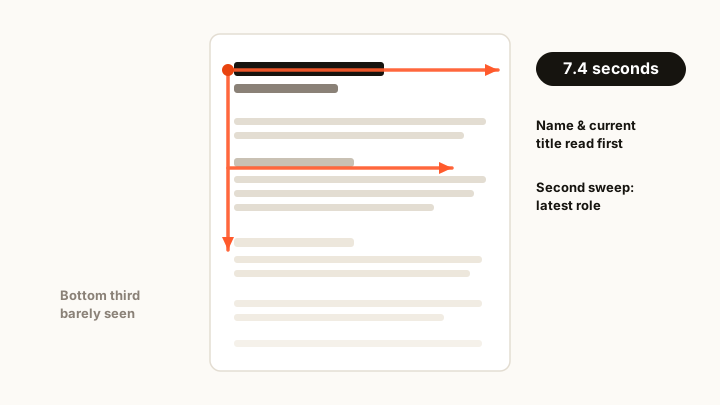
Notice what that list implies. The bottom third of a one-page resume — and everything buried in dense paragraphs — receives a fraction of a second, if that.
The first two lines and the top of your latest job do most of the work. Everything below is confirmation, not discovery.
The study found the resumes that held attention weren’t the most decorated ones. They had simple layouts, clear section headings, and bulleted accomplishments — the exact traits that also survive the parser. (For senior candidates the two-page rule holds, but with a catch: recruiters only spent real time on page two when page one had earned it.)
What earns a second look
A few things reliably pulled the gaze back up and slowed it down. The strongest was numbers. A quantified bullet stops the eye where a qualitative one slides past. Compare a real before-and-after:
- Before: Responsible for improving the onboarding process for new hires.
- After: Cut new-hire onboarding from 3 weeks to 8 days by rebuilding the training flow.
Same job. The second version gives the seven-second reader a result, a magnitude, and a verb in the first three words. The first gives them a job description they have to finish reading to evaluate.
Three levers do most of the work:
- Concrete numbers — percentages, currency, team sizes, timelines. They read as evidence, not opinion.
- Recognisable names — companies, tools, or institutions the reader already trusts, so their brain does less work.
- Strong first verbs — the bullet’s opening word carries more weight than its length. “Led,” “cut,” “shipped,” “grew” beat “responsible for.”
Try it: read only the first two words of each of your bullets, top to bottom. If that alone doesn’t tell a story, the recruiter’s seven seconds won’t either.
Designing for the scan — a checklist
Once you accept the pattern, the fixes are concrete. Work top-down, because that’s how you’re read:
- Put your strongest, most quantified achievement in the first bullet of your most recent role. That is the single most-looked-at line on the page.
- Lead every bullet with a weighty verb, and get a number into the first line wherever it’s honest to do so.
- Use standard section headings — Experience, Education, Skills — so both the parser and the human find things instantly.
- Keep one clean column of real text. No text-in-images, no critical detail in the file header, no two-column tables the ATS reads across.
- Don’t bury the thing you most want seen at the bottom. By the time a rushed reader’s eyes get there, they’ve usually decided.
None of this is about tricking anyone. A parser and a hurried, well-intentioned recruiter are both doing a fast, lossy first pass. Your job is to make the best of what you’ve done impossible to miss in the narrow window each one gives it. Everything true about you can stay on the page — it just has to survive seven seconds and a piece of software to get read at all.
When you’re ready, Kazifi’s resume builder flags weak bullets and buried numbers as you write, and the ATS checker scores the parsed result — the version the software sees — before you apply. For more on beating the first screen, see our guide to a CV format that passes ATS.
Sources: Ladders 2018 Eye-Tracking Study (PDF); HR Dive coverage of the study.