An interview isn’t a personality test you either pass or fail. It’s a small, predictable set of questions asked in a slightly different order each time — which means it rewards preparation more than nerve. Walk in with a framework and you spend the room’s energy on your answers instead of on panic. Here’s the preparation that actually moves the needle.
Research: the homework that shows
Interviewers can tell within minutes who did the reading. Before the day, get concrete on three things:
- The company. What they do, who they serve, and something recent — a launch, a funding round, a change in direction. One specific, current reference in your answers signals genuine interest.
- The role. Re-read the job description and translate each requirement into a moment from your own experience. You’re pre-loading your evidence.
- The people. Look up who you’re meeting. Knowing whether you’re talking to a future manager, a peer, or a leader changes how you pitch an answer.
The questions you’ll almost certainly get
Most interviews draw from the same small pool. Prepare a specific story for each and you’ve covered eighty percent of any conversation:
- “Tell me about yourself.” Not small talk — a structure test. It’s your chance to frame the narrative on your terms. We wrote a full breakdown: “Tell me about yourself” is a structure test.
- “Why this role / why us?” Where your research pays off.
- “Tell me about a time you…” — the behavioural questions (conflict, failure, leadership, a tight deadline). These are the ones people fumble, and they’re the most preparable of all.
- “What’s your greatest weakness?” Answer honestly with something real and what you do about it; the dodge (“I work too hard”) is transparent.
- “Where do you see yourself?” A check on fit and ambition, not a binding contract.
Answer with structure: the STAR method
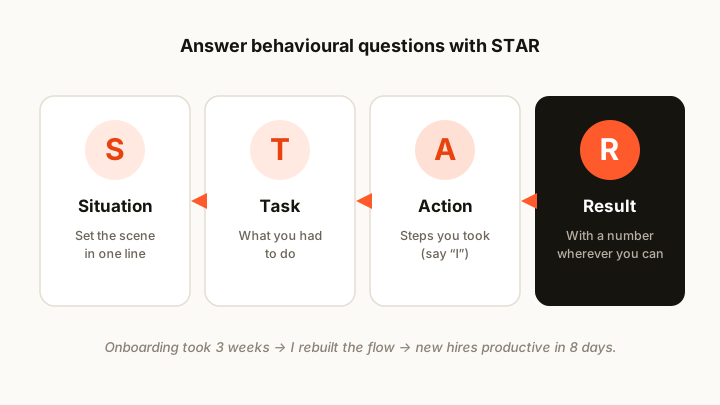
Behavioural questions reward a clear shape. STAR keeps you from rambling:
- Situation — set the scene in a sentence.
- Task — what you specifically had to do.
- Action — the steps you took (say “I,” not “we”).
- Result — how it turned out, with a number wherever you have one.
“Onboarding took three weeks (Situation). I owned fixing it (Task). I rebuilt the training flow and cut redundant steps (Action). New hires were productive in eight days, and we reused it across two teams (Result).” Prepare five or six STAR stories covering your biggest wins, a conflict, a failure, and a leadership moment, and you can adapt them to almost any behavioural question on the spot.
Questions to ask them
“Do you have any questions for us?” is not the end of the interview — it’s part of it. Having none reads as indifference. Prepare three or four that show you’re evaluating them too:
- What does success look like in this role in the first six months?
- What’s the biggest challenge facing the team right now?
- How does the team work together day to day?
Avoid leading with salary and perks in a first conversation; there’s a right time, and it’s usually later.
Logistics and follow-up
Small things cost interviews. Test the video link, audio, and camera ahead of a remote interview; know the route and arrive early for an in-person one. Have your CV, the job description, and your questions in front of you. Afterwards, send a short, specific thank-you note within a day — reference something you actually discussed. It’s a small courtesy that a surprising number of candidates skip.
The point
Preparation turns an interview from an interrogation into a conversation you’ve rehearsed the shape of. Research the company and role, prepare a handful of STAR stories, ready your own questions, and handle the logistics so they never distract you. When you want to rehearse under realistic pressure, Kazifi’s AI interview practice runs you through real questions for your target role and gives feedback on your answers — and keeping your CV current means the stories you tell match the document in their hand.