An academic CV is a different document from the one-page resume most job advice is written for. It’s a complete scholarly record — long, thorough, and organised around your research and contributions rather than a punchy pitch. Get the conventions wrong and a hiring committee notices immediately. This guide covers what an academic CV is, the sections it needs, how to handle length and publications, and how to keep it current.
Academic CV vs. resume: what actually changes
A resume is a marketing document: one to two pages, tailored, results-first, designed to be skimmed in seconds. An academic CV is a comprehensive record used for faculty, postdoctoral, fellowship, and research roles. It can run many pages, it grows over your career, and completeness matters more than brevity. Committees expect to see your full publication record, your funding, your teaching, and your service — not a curated highlight reel.
If you’re moving between academia and industry, you likely need both, kept as separate versions of one underlying record.
The sections, in order
Order signals priority. A widely accepted structure for a research-focused academic CV:
- Contact information and academic credentials — name, degrees, current position. Format credentials cleanly (e.g. Jane Okoro, PhD); don’t crowd the header.
- Education — degrees in reverse-chronological order, with institution, dates, and dissertation/thesis title and advisor.
- Research experience — positions, labs, and what you actually investigated.
- Publications — usually the centrepiece (see below).
- Grants and funding — amounts, agencies, and your role.
- Teaching experience — courses, levels, institutions.
- Presentations, talks, and posters.
- Awards and honours.
- Service, memberships, and references.
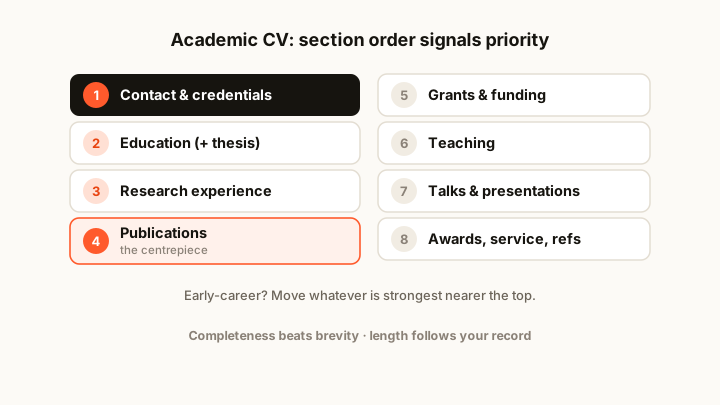
Early-career? Move whatever is strongest nearer the top. A PhD candidate with a thin publication list but strong teaching can lead with teaching after education.
Publications: the centrepiece
For most academic CVs, the publication list is what gets read closest. A few conventions:
- Use a consistent citation style for your field and stick to it exactly.
- Group by type — peer-reviewed journal articles, book chapters, conference papers, preprints, patents — and put peer-reviewed work first.
- Bold or underline your own name in each citation so a reader finds your contribution instantly.
- Mark status honestly: published, in press, under review, in preparation — and never inflate.
Listing patents alongside publications has its own conventions; if that applies to you, see how to list publications and patents on your CV.
Length: complete beats short
Forget the one-page rule — it does not apply here. An academic CV should be as long as it needs to be to represent your record completely. For a PhD candidate that might be two to four pages; for a senior researcher it can be ten or more. What committees dislike isn’t length, it’s padding: repetition, vague entries, or anything that reads as filler. Be complete, be specific, and cut nothing real.
Action verbs and specificity
Even in a formal document, weak phrasing costs you. Lead entries with precise verbs — investigated, designed, secured, supervised, published, presented — and attach specifics: the method, the sample, the grant amount, the venue. “Conducted research” tells a committee nothing; “designed and ran a 200-participant longitudinal study on X, funded by a $180k grant” tells them everything.
Keep it current
An academic CV is never finished. Update it the moment something happens — a paper accepted, a talk given, a grant awarded — rather than reconstructing it under deadline. A quarterly ten-minute pass keeps it accurate; the same discipline that keeps any CV job-ready (see how to keep your CV updated) matters even more when your record is your career.
Tailoring for specific applications
The base academic CV is your master. Specific applications need specific emphasis — and each has its own conventions worth getting right:
- Postdoctoral applications foreground your dissertation and immediate research fit — see formatting a CV for postdoc applications.
- Clinical research roles weight protocols, trials, and regulatory work — see building a CV for clinical research.
- Senior and faculty roles lead with funding, supervision, and impact — see the senior researcher CV masterclass.
- Creative and practice-based fields showcase a portfolio of published or produced work — see the creative-writing CV.
The point
An academic CV rewards completeness, honesty, and clean structure over cleverness. Build one thorough master record, keep it current, and tailor a version for each application. When you’re ready, Kazifi’s CV maker keeps your master academic record and each tailored version in one place, so applying to the next fellowship is an edit, not a rebuild.