A legal CV is read by people trained to notice what is missing. Partners and legal recruiters scan first for admission status and jurisdiction, then for the substance of the matters you have handled. Formatting for a law firm means putting those answers where a trained reader looks for them.
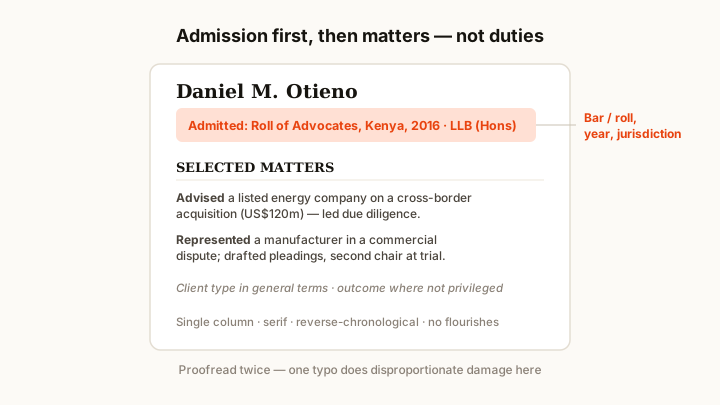
Lead with admission and qualification
Directly under your name, state your admission clearly: the bar or roll you are admitted to, the year, and the jurisdiction. A firm cannot consider you until it knows where you are licensed to practise. Follow with your law degree and class of degree, since firms weigh academic standing more heavily than most sectors.
Describe matters, not duties
The experience section should read as a record of matters and transactions, framed to show your role without breaching confidentiality.
- The matter type: name the practice area and the nature of the work, such as a cross-border acquisition or a commercial dispute.
- Your role: whether you drafted, advised, negotiated, or led, stated precisely.
- Scale and outcome: deal value, jurisdiction, or result, given only where it is not privileged.
- Client type in general terms: “a listed energy company” rather than a name, unless the matter is public.
Keep verbs precise and lawyerly. “Advised,” “drafted,” and “represented” carry meaning to a partner that vaguer words do not. “Advised a listed energy company on a US$120m cross-border acquisition; led due diligence” tells a partner your practice area, scale, and seniority without naming a soul.
Formatting a firm expects
Use a conservative single-column layout, a serif typeface, and reverse chronological order. Two pages is the accepted ceiling for most practising lawyers, longer only for senior partners with a substantial reported-case list. List notable reported cases or publications in a short separate section if you have them. Avoid design flourishes entirely, since the profession reads them as a lapse in judgement — the restraint end of the choices in the CV format and design guide.
Proofread twice. In a document meant to demonstrate precision, a single typo does disproportionate damage.
To build a conservative, correct layout, use the CV maker with the executive templates for senior roles or the ATS-friendly templates where a firm screens digitally. Confirm it parses cleanly with the ATS checker.