List a language when it maps to the job or the market you are applying into, and leave it off when it is a hobby-level skill that just fills space. On a resume crossing borders, a recruiter reads your language line as a claim they may test in the interview, so treat it like one.
When a language earns its place
A second or third language belongs on the page if the employer operates in that market, serves customers in it, or the job description names it. Applying to a Nairobi firm’s Francophone desk, a German subsidiary, or a support role covering Latin America? The language is core evidence, not a footnote. If the role is monolingual and the language never comes up, it is optional flavour at best.
Rate yourself in words a recruiter trusts
The mistake that sinks credibility is vague self-scoring. “Fluent” means you can run a meeting and negotiate in that language, not that you passed it at school. Use a recognised scale so an international reader knows exactly what you mean.
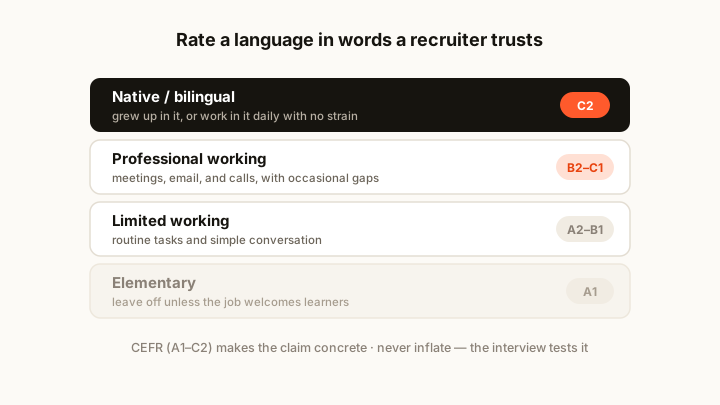
- Native / bilingual: you grew up in it or work in it daily with no strain.
- Professional working: you handle meetings, email, and calls, with occasional gaps.
- Limited working: you manage routine tasks and simple conversation.
- Elementary: leave this one off unless the job explicitly welcomes learners.
Where a framework is expected, the CEFR levels (A1 to C2) — the Council of Europe’s standard scale — or a certificate like DELF, Goethe, or IELTS make the claim concrete and verifiable. CEFR is especially expected across Europe, so on a European-market resume or CV it’s the safest way to state a level.
Placement and honesty
Put languages near your skills section, or in the header if bilingual ability is the whole reason you fit the role. Never inflate a level to look global; a two-minute interview switch into that language will expose it, and that single moment costs you the trust the rest of your resume built. If a language is genuinely core to the role, it can even lead — but only if the claim survives contact.
Run your draft through the ATS checker to confirm the section parses cleanly, and see how expat resumes handle this in our guide to international CV standards. When you are ready to build, the resume builder and an ATS-friendly template keep the layout clean across borders.