There is no single “international” resume. What wins in New York can quietly sink an application in Berlin, Nairobi, or Tokyo — different conventions, different documents, sometimes a different word for the document itself. Applying across borders isn’t about one magic template; it’s about knowing which few things genuinely change and adapting them deliberately. This guide covers exactly that.
CV or resume? It depends where you apply
The first thing to get right is which document you’re even sending, because the words aren’t universal:
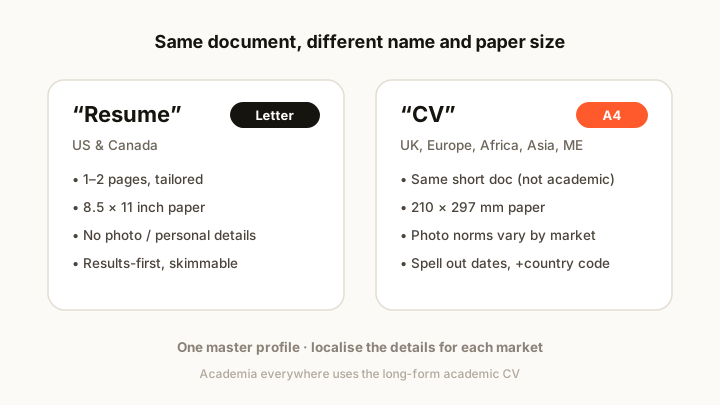
- In the US and Canada, a resume is the default: short, one to two pages, tailored.
- In much of Europe, the UK, the Middle East, Africa, and Asia, CV is the standard term for that same short document — not the long academic CV Americans mean by the word.
- Academia everywhere uses the long-form CV, which follows its own rules (the academic CV guide).
Getting the term and the expected length right is the difference between looking local and looking lost. For a fuller breakdown, see when to use a resume vs a CV in global hiring.
Page format and length
Two mechanical things trip people up when they cross borders:
- Paper size. The US and Canada use Letter (8.5×11”); most of the rest of the world uses A4. Export to the size your target market prints on, or your careful margins shift — see worldwide page sizes: A4 vs. Letter.
- Length norms. One to two pages is safe almost everywhere for a working professional; padding to look senior reads the same badly in every language.
Keep the layout clean and single-column so it survives whatever applicant tracking system the employer runs — the format and design fundamentals don’t change at the border.
What to adapt: the details that localise
Most of a strong resume travels well. A few specifics should be localised every time:
- Phone numbers in full international format (+country code), so a recruiter abroad can actually call you.
- Dates written unambiguously — spell the month (e.g. Mar 2024) rather than 03/04, which means different days in different countries.
- Currency and metrics. When you quote a budget or a result, note the currency, and consider adding a familiar reference point for the target market rather than assuming they’ll convert it.
- Location and availability. If you’re applying remotely or across time zones, state your working overlap plainly.
Language and cultural nuance
Language is where well-meaning resumes leak credibility:
- Write in the market’s English (or language) and register. Avoid idioms and local slang that don’t travel; “smashed my targets” reads oddly in a formal market.
- List languages honestly, with a recognised proficiency level — a genuinely useful signal in international hiring. See whether to include foreign languages.
- Photo and personal-detail norms differ. Some markets expect a photo, date of birth, or nationality; others (notably the US/UK) discourage them to avoid bias. Match the destination, not your home country.
Remote, relocation, and visas
If you’re moving or working across borders, address the practical questions a recruiter is already asking:
- Relocation. Signal readiness clearly rather than leaving them to guess — see how to write a relocation-ready resume.
- Visa and sponsorship. Handle work-authorisation and language requirements head-on; being upfront saves everyone time. See navigating visa sponsorship and language on your resume.
- Fully remote and nomadic work. Presenting a location-independent history well is its own skill — see writing a digital-nomad resume that explains the travel.
What global recruiters actually look for
Across markets, the fundamentals hold: an international recruiter still skims in seconds, still stops on numbers, recognisable names, and strong verbs (see what recruiters see in 7 seconds). What they add is a quick check for fit and friction: can this person legally work here, do they understand our market, and is the document easy to read for someone whose first language may differ from the applicant’s? Reduce friction on all three and you travel well.
The point
Applying internationally isn’t about a different resume for every country — it’s one strong master, localised deliberately: the right document type and length, the right paper size, unambiguous dates and contact details, honest language levels, and a clear answer to the relocation-and-visa question. When you’re ready, Kazifi’s resume builder keeps your master profile in one place so you can tailor a region-ready version in minutes, and the ATS checker confirms it parses wherever you send it.