A long, unformatted list of citations is one of the fastest ways to lose a reader who is not a specialist. Publications and patents are strong evidence, but only if the recruiter can tell in seconds what you contributed and why it mattered. The goal is a clean, consistent block that signals output without demanding the reader parse an academic bibliography.
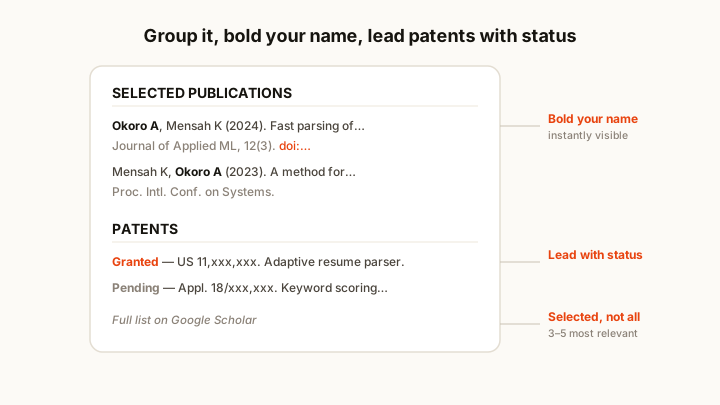
Give them their own section, and keep it consistent
Put publications and patents under clearly labelled headings, separate from work experience. Pick one citation style and hold it for every entry: same order of author, year, title, and venue throughout. If you have many, list the three to five most relevant to this role and add a line noting the rest are available on request or on your Google Scholar profile.
- Bold your own name in the author list so your contribution is instantly visible.
- Lead patents with status: “Granted,” “Pending,” or the application number, then the title.
- Add a one-line plain-English note on high-impact work: what problem it solved or where it was cited.
- Link out to a DOI, repository, or patent office page rather than pasting long URLs inline.
Match the depth to the reader
An academic or R&D panel will read the venue and the methodology, so full citations belong there — and on a full academic CV they sit in their own weighted section (see the academic CV guide). A hiring manager for an industry role often just needs proof that you ship and that others build on your work. For those roles, trim to a short “Selected Publications” list and let a metric do the talking: number of citations, adoption, or a product that shipped off the back of the patent.
The same entry, framed for two readers: for a research panel, the full citation with venue and co-authors; for an industry manager, “Co-invented the adaptive parser now in production (US patent granted, 2024) — cut processing time 60%.” Same work, different altitude.
Keep it machine-readable too
Applicant tracking systems choke on multi-column layouts and unusual characters. Keep the section single-column, use standard headings, and avoid decorative dividers so the parser reads every line — the same rules that keep any CV passing the ATS.
Once the section is drafted, run it through the resume checker to catch formatting that breaks parsing, and confirm the layout survives an ATS scan. The resume builder keeps these sections single-column by default, and the executive templates give a senior research profile room to breathe.