If you apply across borders, the first decision is not what to write, it is which document to send. In the US and Canada a resume is a one or two page pitch. In the UK, Ireland, and most of Europe a CV means roughly the same thing. In academia and much of the Gulf, a CV is a long, complete record of everything you have done. Guess wrong and a recruiter reads your document as either padded or thin before they read a word of it.
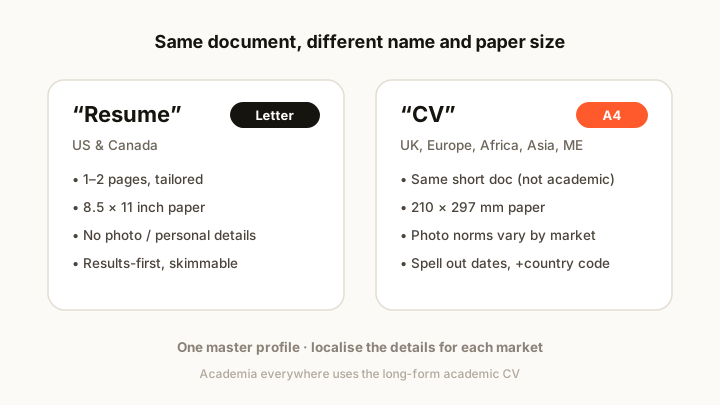
What the two words actually mean
The confusion is regional, not universal. Map it before you apply.
- North America: “resume” is the short, targeted document. A “CV” here means the long academic version and is rarely asked for outside research or medicine.
- UK, Ireland, Australia, New Zealand: “CV” is the standard job document, usually two pages, and behaves like a US resume.
- Continental Europe: “CV” is standard, often two pages. The Europass CV — the European Union’s own free, standardised format — is common for public-sector and cross-EU roles, and a safe default when a listing points you to it.
- Academia and research, anywhere: a full CV listing publications, grants, teaching, and conferences, with no length limit. That’s a different document with its own rules — see the academic CV guide.
Read the posting, not the tradition
The safest move is to give the document the exact name the job ad uses. If a Berlin startup asks for a “resume,” send a two-page targeted document even though the country norm is “CV.” Recruiters mirror the market they hire from, and an international team often uses American vocabulary regardless of where the office sits. When a listing says CV in a UK or EU context, they want the working document, not your life’s bibliography.
Length follows the same logic. Match the local expectation: one to two pages for most private-sector roles, longer only when the field or the ad explicitly calls for a complete record.
The details that change with the market
Beyond the name, a few specifics localise. Paper size shifts from Letter (US/Canada) to A4 (most of the world). Photo, date-of-birth, and nationality are expected in some markets and discouraged in others to avoid bias. Dates are safest spelled out (Mar 2024), and phone numbers should carry a country code. The full checklist lives in the international resume guide.
When you genuinely need both
Applying to a US company and a UK company in the same week means keeping two versions with the same content and different labels and lengths. Build the core once, then adapt — the same master-and-variants discipline that keeps any job hunt fast (see how to manage multiple CV versions).
Start with the resume vs CV guide for the full breakdown, keep the short version tight with the one-page templates, and use the CV maker to hold both versions in one place. For expat specifics, see international CV standards for expats.